

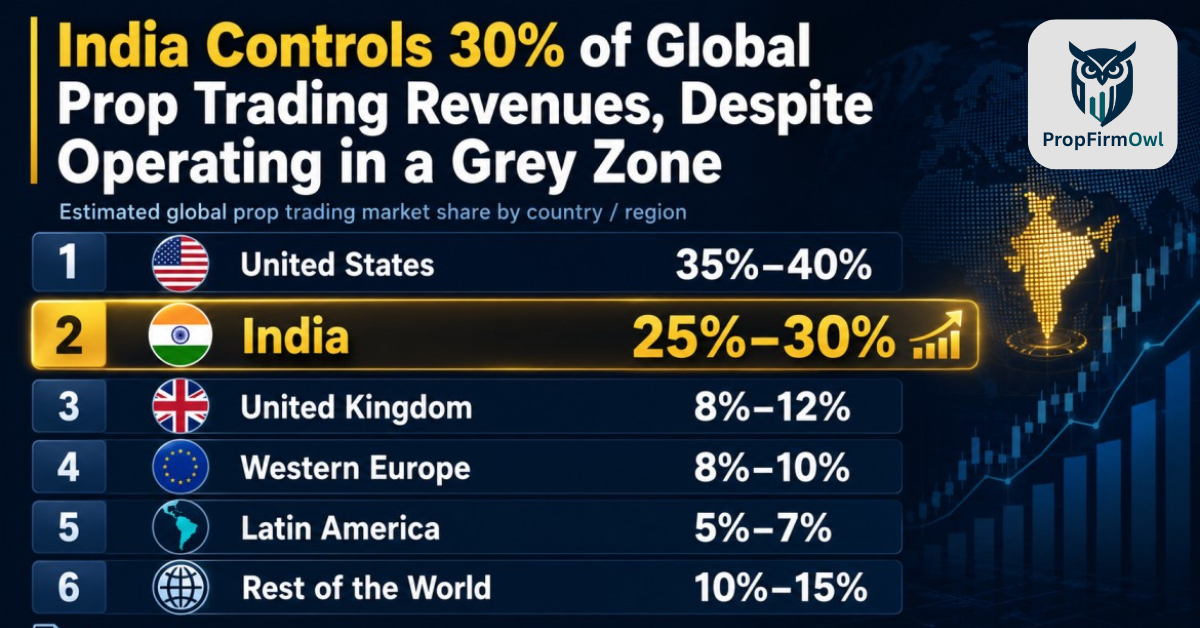
New Delhi: India is now one of the most important markets for global prop trading firms. Industry estimates suggest that Indian traders contribute nearly 25% to 30% of global prop trading revenues. Market traffic estimate by Christian Görgen shows that India and the United States dominate organic traffic for many prop firms with India bringing almost 40% of organic traffic for leading prop firm platforms.
The reason is simple. Indian traders are looking for low-cost access to large trading accounts, dollar-based payouts and global markets. Prop firms offer this through paid challenges, demo-style accounts and profit-sharing models.
But there is one problem. The market is growing faster than the rules around it.
Disclaimer: This article is for information only and is not legal, tax or financial advice. FEMA, GST and income-tax treatment can vary by facts, platform and payment method. Consult a qualified professional before acting.
Why India Matters to Prop Firms
Prop firms promote funded accounts through YouTube, Telegram, Discord, Instagram etc. They avoid direct words like “forex” or “CFDs” in India-facing marketing. Instead, they use terms such as education, evaluation, demo account, skill test or funded challenge. This is where the story becomes more complex.
India gives foreign prop firms 3 things:
- large trader interest: 20-30% market
- low customer acquisition cost: fastest payback markets
- strong social media reach : 500 million active social media users
Where the Legal Risk Starts
For Indian traders, the first compliance question starts before any payout. It starts when they pay a foreign prop firm. Most traders pay the challenge fee through cards, payment gateways or wallets. Many assume this is allowed under the Liberalised Remittance Scheme, or LRS. But LRS is not a free pass for every foreign payment.
RBI allows resident individuals to remit up to USD 250,000 per financial year under LRS.
However, this limit applies only to permitted current or capital account transactions. So the purpose of payment matters. If the payment is clearly for evaluation, software or training access, the position may be different. But if the payment works like margin money, trading deposit or access to offshore forex exposure, FEMA risk can increase.
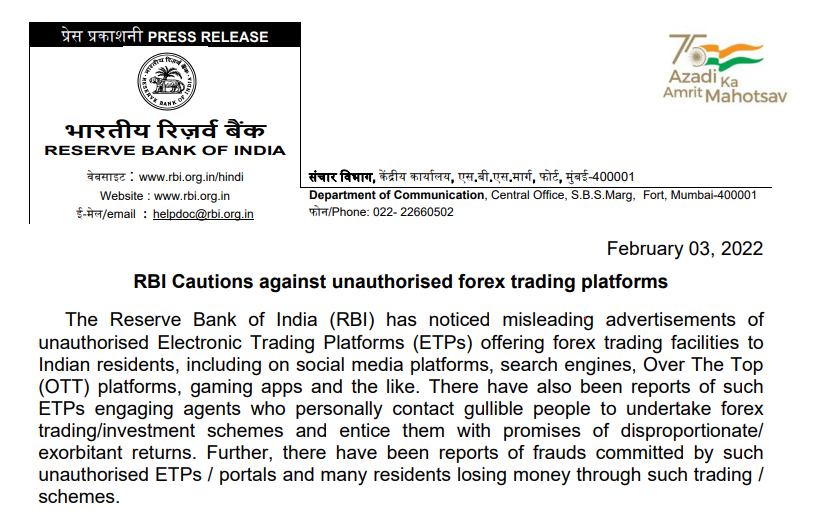
This is important because RBI has warned Indian residents against using unauthorised forex trading platforms. RBI also says its Alert List is not complete. This means a platform not appearing on the list is not automatically safe.
Demo Accounts Make the Legal Question Harder
The biggest grey area is the difference between simulated and real-money accounts. Many prop firms say traders are not trading live capital during the evaluation stage. They trade on demo or simulated accounts. If they pass the rules, they may receive a payout based on the firm’s internal model.
This creates a key question: is the Indian trader actually trading foreign forex or derivatives, or only providing a skill-based service to a foreign company?
There is no simple answer. It depends on the contract, account type, instruments traded, payout method and how the firm uses the trader’s activity. Some firms may use simulated trading only. Others may copy or hedge trades in real markets.
This is why the sector operates in a grey zone. A demo account may reduce direct trading exposure, but it does not remove every FEMA, tax or reporting issue.
Income Classification of Prop Payouts
Tax reporting is an area where many Indian traders get confused. Some traders assume prop firm payouts are entirely capital gains but that may not always be correct. Capital gains apply when a person owns and sells a capital asset. In many prop firm models, the trader does not own the trading account, the capital or the asset. The payout may be linked to performance, which is not same as profit from assets owned by the trader.
Depending on facts, the income may be treated as business income, professional income, contractual income or income from other sources.
For regular traders, business income may be a stronger position. This can apply where the trader takes repeated challenges, uses paid trading tools, maintains systems and receives payouts as a regular activity. If income is treated as business or professional income, ITR-3 may become relevant.
GST and Export of Services Question
GST becomes important when the trader is treated as providing a service to a foreign prop firm. Under GST rules, export of services requires key conditions:
- The supplier should be in India. The recipient should be outside India.
- The place of supply should be outside India.
- Payment should be received in convertible foreign exchange or in a permitted mode.
If these conditions are met, the payout may be examined as export of services. A registered trader may need invoices, bank remittance proof, GST returns and, in some cases, LUT documentation. Small or occasional traders may have a different position but regular overseas payouts cannot be ignored.
Conclusion
India’s prop trading boom shows clear demand from retail traders. But the legal and tax position is still not fully settled and operating in legal grey area. The safer view is simple: Indian traders should not treat foreign prop firm payouts as casual online income. They should treat them as foreign-linked receipts and check FEMA, GST and income-tax reporting before filing returns and keep challenge fee invoices, prop firm agreements, payout statements, dashboard screenshots, bank credit records and currency conversion details.
